Why Most Bra Tops Fail Larger Busts - and What to Look For Instead
Quick Answer: Most bra tops rely on compression from a single stretch layer, which stops providing meaningful support above roughly a D cup because the force required exceeds what a comfortable band can generate. What works instead is encapsulation - separate moulded cups - plus a wide non-stretch band, adjustable straps, and a back closure. Size the band snugly and the cup generously, and expect to pay more for construction rather than fabric.
The standard advice for finding a bra top that supports a larger bust is to look for one in your size. This misses the actual problem, which is structural: the way most bra tops are built cannot produce enough support at larger cup volumes no matter what size is printed on the label.
Here’s what’s actually happening and what to look for instead.

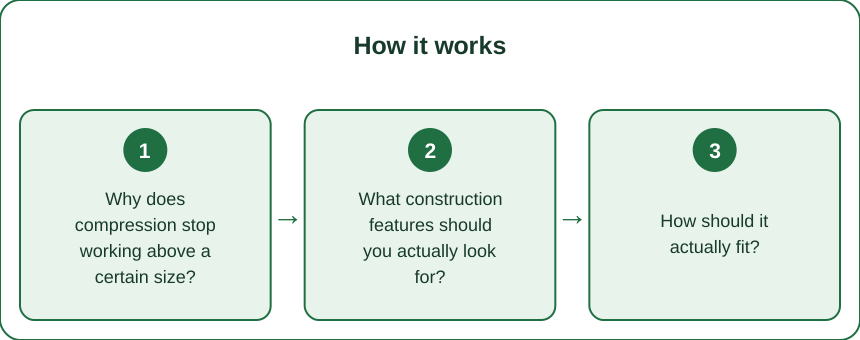
Why does compression stop working above a certain size?
Because the amount of force needed scales with breast mass, and a stretch band can only generate so much before it becomes intolerable.
Compression works by pressing breast tissue against the chest wall. One stretch layer, tension around the ribcage, tissue held in place. At smaller cup volumes this works well - the mass is low, the required force is modest, and a comfortable band supplies it.
As cup volume increases, the mass increases substantially, and so does the movement force during activity. To restrain that with compression alone, the band tension has to rise proportionally. At a certain point the tension required to actually support becomes the tension that restricts breathing, digs into the ribs, and causes shoulder and neck pain.
This is why the common experience of sizing down doesn’t work. A tighter band in a compression garment gives more compression and more discomfort, without ever reaching adequate support. The mechanism has a ceiling.
Encapsulation works differently. Separate cups surround each breast individually and control movement in all directions, particularly the vertical and lateral movement that compression handles worst. The support comes from structure rather than from pressure, which is why a well-constructed encapsulation bra can feel less tight while supporting far more.
The best garments for larger busts do both - encapsulation for the primary support, light compression on top for extra control. This is standard in dedicated sports bras and rare in bra tops, which is the crux of the whole problem.
What construction features should you actually look for?
Seven, in rough order of importance.
1. Moulded or seamed separate cups. Not a shelf bra, not a single stretch front panel. You should be able to see two distinct cups in the product photos. A centre seam or a diagonal seam across each cup indicates a shaped structure rather than a flat panel.
2. A wide band with minimal stretch. The band supplies the large majority of the support in any well-fitting bra. Wider distributes the load; low-stretch means it holds rather than gives. A narrow elastic band is a strong indicator the garment isn’t built for volume.
3. A back closure - hooks, not pull-on. Adjustability matters, band elastic relaxes over time, and pulling a very snug non-stretch band over your head is impractical. A hook closure is one of the clearest signals of a garment actually designed for larger busts.
4. Adjustable straps. Non-negotiable above a D cup. Torso length varies independently of cup size, and fixed straps mean the cup sits wrong on most bodies.
5. Wider straps, ideally with a racerback or J-hook option. Narrow straps concentrate load on a small area of the trapezius, which is the direct cause of the grooving and shoulder pain many people assume is unavoidable.
6. Underband-to-cup construction that isn’t just elastic. Look for a bra-style construction with a proper frame.
7. Power mesh or a lined front panel. Adds control without adding compression tightness.
Red flags that tell you it won’t work: ‘one size fits most’, S/M/L sizing rather than band-and-cup, ‘removable pads’ as the only structure, a single unbroken stretch front, and any product photo where the model is clearly a small cup size with the garment lying flat across the chest.

How should it actually fit?
Four checks, and the first one is where most people are getting it wrong.
The band should be snug and level. Roughly 80 percent of support comes from the band, not the straps. It should sit horizontally around the ribcage, not riding up at the back, and you should be able to slide two fingers under it with some resistance - no more.
Most people wear a band too loose and straps too tight. The tell is straps digging into the shoulders while the back of the band rides up. The fix is a smaller band and a larger cup, which usually feels counterintuitive and immediately better.
The cups should fully contain the tissue. No spillage over the top or at the sides near the underarm. Any gaping at the top means the cup is too large or the shape is wrong for you.
The centre should sit flat against the sternum. If there’s a gap, the cups are too small - this is the single most reliable indicator of cup size in a fitted bra and it works for bra tops with structured cups too.
The straps should be adjusted so they carry some load but not most of it. Two fingers under the strap. If loosening the straps causes everything to drop, the band isn’t doing its job.
The movement test that matters: jump ten times in the fitting room, or run in place for fifteen seconds. Sitting still tells you almost nothing about a garment designed for movement, and this is the test people are too self-conscious to do and most need to.
On sizing between brands: band-and-cup sizing is not standardised across manufacturers, and sports bra sizing varies even more than lingerie. Your size is a starting point for the first try-on, not a fact about you.
5 Mistakes Everyone Makes With Bra Tops
Mistake 1: Sizing down for more support. Understandable and wrong. A smaller cup in the right band gives spillage and discomfort without more support. What you usually want is a smaller band with a larger cup - the same volume, better anchored.
Mistake 2: Judging support standing still. Everything looks fine in the mirror when you’re not moving. Jump. If the fitting room feels too public, do it at home before removing the tags.
Mistake 3: Buying for the outfit rather than the activity. The bra top that works under an open shirt for coffee is not the one for a running class, and expecting one garment to do both is the source of a lot of disappointment. Above a D cup these are genuinely different products.
Mistake 4: Keeping them far too long. Elastic degrades, and the band loses tension well before the fabric looks worn. A frequently worn supportive bra top has a working life of roughly six to twelve months. If you’re on the tightest hook and it still feels loose, it’s finished.
Mistake 5 - the one that undoes everything else: tumble drying and using fabric softener. Heat destroys elastane, which is the fibre doing all the structural work, and softener coats fibres and reduces their recovery. Cold wash, hang dry, no softener roughly doubles the useful life of a garment that isn’t cheap to replace.
FAQ: Bra Top Support Questions, Answered
Can I wear a proper sports bra under a bra top for more support?
You can, and plenty of people do for higher-impact activity. It’s warm and bulky, which is why it’s a workaround rather than a solution, but it works. The better long-term answer is one well-constructed garment.
Are more expensive ones actually better?
For larger busts, generally yes - not because of fabric but because encapsulated construction, hook closures, adjustable straps, and graded cup patterns cost more to design and manufacture. That’s a real difference rather than a brand premium. Below a D cup, the price-performance relationship is much weaker.
How do I know if my band size is right?
Undo the straps entirely. If the band alone stays in place and stays level when you raise your arms, it fits. If it rides up, go down a band size and up a cup size to keep the volume the same.
Why does the same size fit differently in every brand?
Because sports bra sizing isn’t standardised, cup grading differs between manufacturers, and ‘large’ means whatever a given brand decided it means. This is why buying without trying on, or without a returns policy you’ll actually use, rarely works above a D cup.
Is it bad to wear one all day?
Generally fine if it fits properly. Discomfort, marks that persist, or shoulder and neck pain after a day of wear are signs of poor fit rather than of prolonged wear - usually a too-loose band transferring load onto the straps.
TL;DR:
- Compression-only construction has a support ceiling; above roughly a D cup it can’t generate enough force comfortably
- Look for separate moulded cups, a wide low-stretch band, hook closure, and adjustable wide straps
- The band does around 80 percent of the work - most people wear it too loose and the straps too tight
- Fix by going down a band size and up a cup size, keeping the volume the same
- Test by jumping, not by standing still
- Cold wash, hang dry, no softener; replace every six to twelve months of regular wear
It isn’t that the sizes don’t exist. It’s that a single stretch layer can’t hold what a structured cup can, and knowing the difference is what stops you buying the same disappointing garment repeatedly.
See It in Motion
Seen here: Racerback Tank Top - White — shop similar styles on bubblelime.com
Keep Reading
This article is for general informational and styling purposes only. Fit, sizing, and product availability may vary.