Light, Medium, High: What Bra Top Support Levels Actually Mean
Quick Answer: Light support is a shaped layer for yoga, pilates, and lounging. Medium is for cycling, hiking, weights, and moderate movement. High is compression plus encapsulation for running, HIIT, and jumping. Support level is not standardised between brands, so read the construction - band width, strap design, and whether cups are separated - rather than trusting the word on the tag.
The words on the label are marketing categories, not measurements. There is no industry standard defining what medium support means, which is why one brand’s medium is another brand’s high, and why a bra top that felt supportive in the fitting room turns out not to be twelve minutes into a run.

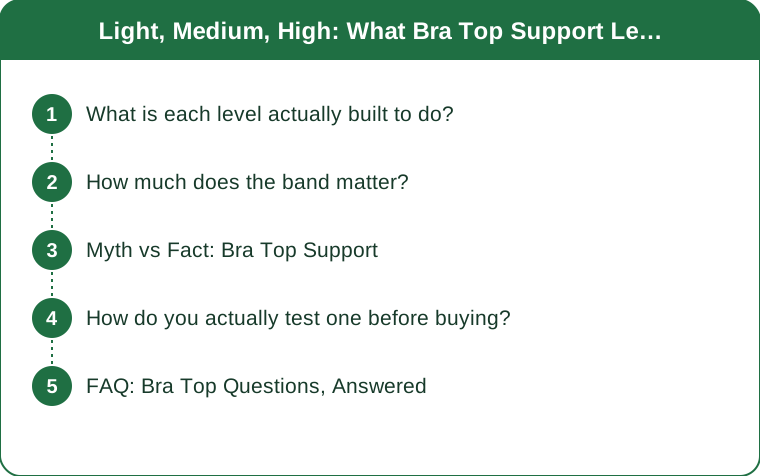
What is each level actually built to do?
The mechanism is what distinguishes them, and it is visible in the construction.
Light support works by covering and lightly containing. Thin elastic band, thin straps, single layer of stretchy fabric, no separation between cups, often a removable pad. It restricts movement barely at all. Built for yoga, pilates, barre, stretching, and wearing under things.
Medium support adds compression. A wider band, thicker straps, a doubled or bonded layer of fabric, sometimes a partial back structure. It presses breast tissue toward the chest wall to reduce movement. Built for cycling, hiking, strength training, rowing, and most gym work.
High support combines compression with encapsulation - individual cups that hold each breast separately, usually with a wide band, adjustable straps, and often a back closure. This is a genuinely different mechanism, and it is what controls vertical movement during running and jumping.
The critical detail most people miss: compression alone works reasonably for smaller cup sizes and progressively less well as cup size increases. Above roughly a D cup, compression-only designs struggle regardless of how tight they are, and encapsulation stops being a preference and becomes the thing that works.
How much does the band matter?
More than everything else combined. The band provides the substantial majority of the support in any bra, sports or otherwise - commonly estimated at around 80 percent - and the straps provide the rest.
That has three practical consequences.
Fit the band first. It should be firm and level all the way round, sitting in the same horizontal plane at the front and the back. If it rides up at the back, it is too loose - and a band riding up is the most common fit fault in bra tops.
Tightening the straps does not fix a loose band. It transfers load to your shoulders and traps, which is why people finish runs with sore shoulders and blame the bra’s padding. The bra was the wrong band size.
Wide bands out-support narrow ones at the same tension, because the load spreads over more area and the band is less likely to roll. A rolled band has effectively become a narrow band, which is why cheap bra tops that roll under the bust feel like they lose support during a session.
The two-finger test still applies: you should be able to slide two fingers under the band with effort, not comfort. And remember that bands loosen with wear - a bra top that was firm a year ago may now be a size too big without ever looking different.
Myth vs Fact: Bra Top Support
Myth: Tighter is more supportive. Fact: Correctly fitted is more supportive. A too-tight band restricts breathing and causes chafing without adding meaningful support, and it wears out faster because the elastic is permanently overstretched.
Myth: You only need high support if you are large-chested. Fact: Movement during running is significant at every size, and high support reduces discomfort and the tissue strain associated with repeated movement across the range. Smaller sizes have more options that work, not less need.
Myth: A bra top with a removable pad is more supportive. Fact: Pads shape, they do not support. They also trap moisture and are the first thing to distort in the wash.
Myth: You can wear the same bra top for everything. Fact: You can, and you will be over-supported and uncomfortable in yoga or under-supported and uncomfortable running. Two bra tops covering the ends of your range beat one that half-works everywhere.
Myth: Sports bras last for years. Fact: With regular use and washing, elastic degrades noticeably within about 6 to 12 months. If the band feels easy to pull away from your body, it has stopped doing its job - and that is usually long before it looks worn.
How do you actually test one before buying?
In the fitting room, in this order:
1. Band check. Fasten or pull it on, then run two fingers under the band all the way round. Firm, level, no ride-up when you raise your arms.
2. Strap check. Slide a finger under each strap. It should lift about an inch with light tension. If the straps are digging in, either the band is too loose or the straps are over-tightened.
3. Cup check. No spillage at the top or the underarm, and no wrinkling or gapping, which means the cup is too big. In encapsulated designs, the seam between the cups should sit flat against the sternum.
4. The jump test. Jump ten times, on the spot, in the fitting room. Feeling self-conscious is not a reason to skip it - this is the only test that tells you anything about high-impact performance, and a bra can pass every static check and fail this one.
5. The reach test. Raise both arms overhead. The band should not lift more than an inch.
For everyday wear rather than training, the same band and strap checks apply, but the jump test is optional. And if the bra top is going under clothes all day, check it after ten minutes of sitting - some designs that feel perfect standing dig in badly the moment you slouch.
FAQ: Bra Top Questions, Answered
What support level do I need for running?
High support, with encapsulation if you are above roughly a D cup. Compression-only designs increasingly struggle with vertical movement as cup size rises.
Is medium support enough for weight training?
Usually yes. Lifting involves relatively little vertical bounce compared with running, so medium support with a firm band is comfortable for most people. If your session includes jumping or sprinting, go high.
How often should I replace a sports bra?
Every 6 to 12 months with regular use, or sooner if the band has lost tension. Wash cold, never tumble dry, and rotate between two - elastic recovers with rest, so two bras last more than twice as long as one.
TL;DR:
- Light is a shaped layer, medium adds compression, high adds encapsulation - the mechanism, not the word, is what matters.
- The band does around 80 percent of the work; tightening the straps just moves the load to your shoulders.
- Above roughly a D cup, encapsulation stops being optional for high-impact activity.
- Do the jump test in the fitting room, and replace when the band loses tension rather than when it looks worn.
Support labels are a starting point and nothing more. Reading the construction takes ten seconds and tells you far more than the tag ever will.
See It in Motion
Keep Reading
This article is for general informational and styling purposes only. Fit, sizing, and product availability may vary.