Why Your Bra Top Fits Differently After Twenty Washes
Quick Answer: The elastane in a bra top degrades from heat, chlorine, body oils, and mechanical stress - and the dryer is by far the worst offender. Expect a well-cared-for bra top to hold its support for roughly a year of regular wear, or 30-40 washes. Wash cold, never tumble dry, rotate between at least three, and replace when the band no longer stays put with the straps loosened.
Most people replace bra tops when the fabric looks worn. The support usually goes months before the appearance does, which is why so many people are wearing tops that stopped working a while ago.

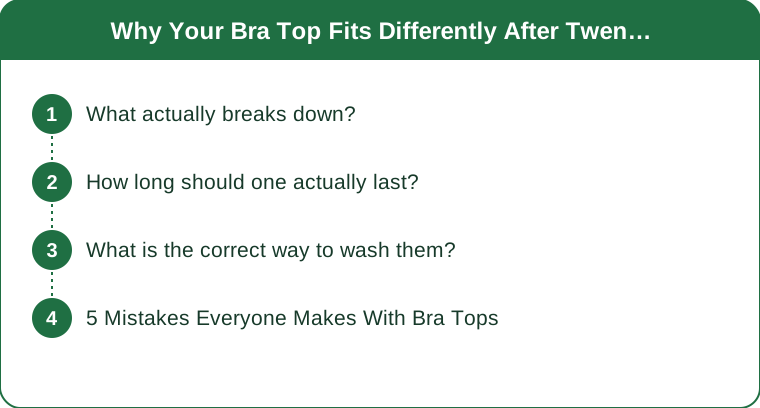
What actually breaks down?
The elastane, not the fabric it is knitted with.
A bra top is typically a blend - nylon or polyester for the body of the fabric, and a small percentage of elastane for the stretch and recovery. The nylon or polyester barely degrades. The elastane does all the work and takes all the damage.
Four things damage elastane:
Heat is the worst. Elastane fibres are permanently altered by high temperature. A hot wash and a tumble dryer cycle do more damage in one round than weeks of wear. This is the single biggest factor and the easiest to control.
Body oils and sweat. Oils penetrate the fibre and break it down over time, which is why a bra top worn for a sweaty workout and left in a bag for two days is meaningfully worse off than one washed promptly.
Chlorine and hard water. Chlorine is aggressive on elastane, which is why swim-specific fabrics use higher-resistance blends. Pool use accelerates degradation substantially.
Mechanical stress. Repeated stretching, especially wearing it damp or pulling it on aggressively, fatigues the fibre. Wearing the same top two days running gives the elastane no recovery time, which is a real effect and the reason rotation matters.
What degradation looks like: the band no longer grips, the fabric feels slightly slack rather than springy, and the top rides up during activity. The fabric itself can look perfectly fine at this point, which is exactly why people keep wearing them.
How long should one actually last?
Roughly six to twelve months of regular wear, depending on use and care.
A rough guide:
- Worn twice a week for low-impact activity, washed cold and air dried: around a year, sometimes longer
- Worn four times a week for running or high-impact training: six to nine months
- Tumble dried regularly: three to six months, sometimes less
- Used for swimming in chlorinated pools: three to four months for a non-swim-specific top
A more useful measure than time: about 30-40 wash cycles for most bra tops, which is why washing after every wear shortens the life more than people expect. This is a real trade-off, because not washing a sweaty top is worse for both the fabric and your skin.
The compromise that works: rotate between at least three tops. This spreads the wash cycles, gives each one recovery time between wears, and roughly triples the useful life of the set rather than just dividing the wear across them.
How to test whether yours is done. Put it on and loosen or ignore the straps entirely. The band should still stay in place on its own. A properly functioning bra top gets the large majority of its support from the band, not the straps. If it rides up as soon as the straps are not doing the work, the elastic in the band has gone and the top is finished, regardless of how it looks.
Second test: hold the band and stretch it, then let go. It should snap back immediately and completely. If it returns slowly or does not fully recover, the elastane is fatigued.

What is the correct way to wash them?
Cold, gentle, no fabric softener, and never in the dryer. The last one is most of the benefit.
The full method:
- Rinse after a sweaty session if you cannot wash it right away. Thirty seconds under cold water removes most of the salt and a good portion of the oils, and it makes a genuine difference to how long the top lasts
- Wash cold, 30C or below. Hot water is the fastest way to destroy elastane
- Use a mesh bag. It prevents the straps stretching and stops hooks and zips on other garments catching the fabric
- Gentle or delicate cycle, and do not overload the machine
- Skip the fabric softener entirely. It coats synthetic fibres, which reduces both moisture-wicking and breathability, and the coating traps odour rather than removing it. This is the most common well-intentioned mistake
- Use less detergent than you think. Excess detergent builds up in technical fabrics and holds smell
- Never tumble dry. Not even on low. This is the single highest-impact rule on the list
- Dry flat or hang, out of direct sunlight. UV degrades elastane too, so drying on a sunny balcony all day is not ideal
On hand washing: better for the fabric and rarely worth the time for most people. A cold gentle machine cycle in a mesh bag is close enough that the difference does not justify the effort.
For persistent odour, which is the most common complaint with technical fabrics: soak for 20-30 minutes in a solution of cold water and a cup of white vinegar before washing. Vinegar breaks down the residue that holds the bacteria producing the smell. Do this occasionally rather than every wash.
Storage matters slightly too. Lay them flat or fold them rather than hanging by the straps, and never fold a moulded cup inside out - it permanently distorts the shape.
5 Mistakes Everyone Makes With Bra Tops
1. The dryer. Once through a hot cycle does measurable damage; regularly is what turns a year-long garment into a four-month one. This one mistake accounts for most premature failures.
2. Fabric softener. It coats the fibres, reduces wicking, and traps odour. People use it because the top has started to smell, which makes the problem worse in a loop that ends with the top being thrown out.
3. Wearing the same one two days in a row. Elastane needs recovery time between wears to return to its original length. Rotating three tops does not just spread the wear - it lets each recover, which extends the life of all three.
4. Tightening the straps to compensate. When the band goes, the instinct is to pull the straps tighter. This shifts the load onto your shoulders and neck, which is where the discomfort and the marks come from. Straps should be a minor adjustment, not the support system, and needing to over-tighten is a replacement signal, not a fit fix.
5. Judging by appearance. The third mistake surprises people, but this is the expensive one. The knit face, the colour, and the print all outlast the elastane by months. A top that looks new can have no support left in it, and a lot of people are training in exactly that.
TL;DR:
- Elastane is what degrades - from heat, oils, chlorine, and mechanical stress - not the outer fabric
- The dryer is the single biggest killer; cold wash and air dry is most of the answer
- Skip fabric softener entirely and use less detergent than you think
- Rotate at least three so each gets recovery time between wears
- Test the band with the straps loosened - if it rides up, it is finished regardless of how it looks
Expect around a year, or 30-40 washes, from a well-treated bra top. Most people get half that from the dryer alone, and never notice the support went because the fabric still looks fine.
See It in Motion
Seen here: Racerback Tank Top - White — shop similar styles on bubblelime.com
Keep Reading
This article is for general informational and styling purposes only. Fit, sizing, and product availability may vary.